
Bounce Houses for Different Age Groups: How to Match the Right Inflatable to Your Child's Age
You've decided to rent a bounce house for your child's party, but when you start looking at options, you realize they're not all the same. Some have towering slides. Others look scaled for preschoolers. A few even advertise "teen-friendly" features.
The challenge: bounce houses are designed for specific age ranges, and choosing the wrong one creates safety risks, disappointed kids, or both. A toddler can't safely climb into a unit built for 10-year-olds. A group of middle schoolers will feel cramped in a small residential jumper.
This guide explains how bounce houses differ across age groups, what features matter at each developmental stage, and how to choose an inflatable that matches your guests' ages, abilities, and energy levels.
Table of Contents
- What Age Is a Bounce House Good For?
- Which Age Group Are You Planning For?
- Toddlers (Ages 2-5): Low Entry, Soft Features, Constant Supervision
- Elementary School Kids (Ages 6-9): Standard Bounce Houses and Entry-Level Combos
- Tweens and Preteens (Ages 10-12): Bigger Units, More Challenges
- Teens (Ages 13+): Adult-Rated Inflatables and Interactive Games
- Mixed-Age Parties: How to Keep Everyone Safe and Happy
- How Size and Weight Capacity Relate to Age
- Frequently Asked Questions
Which Type of Party Planner Are You?
👶 Planning a Toddler Birthday
You need a low-entry, enclosed unit with gentle features. Your biggest concern is keeping older siblings out so your toddler isn't overwhelmed or accidentally knocked over.
🎈 Hosting Elementary-Age Kids
You want a unit with enough space for active play—maybe a slide or basketball hoop. Your kids have the energy to bounce for hours, so you need a setup that keeps them engaged without constant adult intervention.
🏀 Entertaining Teens or Tweens
You're looking for something that doesn't feel babyish—obstacle courses, large combo units with competitive elements, or interactive games. Your guests are bigger, stronger, and need equipment rated for their size and activity level.
What Age Is a Bounce House Good For?
Most bounce houses accommodate children aged 2 through 12, though many larger units are rated for teens and even adults. The range exists because bounce houses vary significantly in size, structure, and design features.
Age recommendations are based on three factors: physical development (balance, coordination, climbing ability), safety considerations (entry height, collision risk with larger kids), and engagement level (whether the features match what that age finds fun).
A 3-year-old lacks the motor control to safely climb a 4-foot slide ladder. A 12-year-old will be bored in a small 10x10 jumper with no features. Matching the inflatable to the developmental stage ensures both safety and satisfaction.
💡 Pro Tip: Manufacturers list age ranges on every unit, but those are maximums, not requirements. A bounce house rated "ages 3-12" doesn't mean a 3-year-old and a 12-year-old should use it at the same time. Age separation is the single most important safety practice for inflatable rentals.
Which Age Group Are You Planning For?
Before you start comparing specific models, identify your guest list's age composition. The answer determines which category of inflatable you should be looking at.
Toddler Party (Ages 2-5)
Look for dedicated toddler bounce houses or "tot jumpers." These feature low entry points (12-18 inches), smaller bounce areas, mesh walls for visibility, and gentle slide angles.
Key concern: Preventing older siblings from joining. Even a 7-year-old can accidentally injure a toddler in a shared bounce space.
Elementary Party (Ages 6-12)
Standard bounce houses and combo units work well. These kids have the coordination for slides, climbing walls, and basketball hoops. They can handle taller entry points and more vigorous play.
Key concern: Ensuring the unit is large enough that 8-10 kids aren't constantly colliding. Space matters more than features at this age.
Teen or Tween Event (Ages 13+)
You need adult-rated inflatables—obstacle courses, large combo units, interactive games, or mechanical bull setups. Teens want competition and physical challenge, not just bouncing.
Key concern: Weight capacity and structural durability. Teens are heavier and more forceful—equipment must be rated for their size.

Toddlers (Ages 2-5): Low Entry, Soft Features, Constant Supervision
Toddler bounce houses are purpose-built for children aged 2 through 5, focusing on safety over excitement. These units prioritize accessibility, visibility, and gentle play.
What Makes a Bounce House Toddler-Appropriate?
Look for these design elements:
- Low entry step (12-18 inches): Toddlers can climb in without help. Standard bounce houses have 3-4 foot entries that require lifting.
- Smaller bounce area: Limits how high toddlers can jump, reducing fall risk. A 10x10 or 13x13 footprint is ideal.
- Mesh side walls: Parents can see inside at all times. Full vinyl walls obscure your view.
- Gentle slide angles (if included): Short slides with gradual slopes—nothing steep or fast.
- Bright, simple themes: Cartoon characters, animals, primary colors. No intimidating designs.
Is a Bounce House Safe for Toddlers?
Yes, when you choose age-appropriate equipment and supervise actively. The single biggest risk for toddlers in bounce houses is mixing with older children. A 7-year-old's weight and jumping force can easily knock over a 3-year-old, even unintentionally.
Safe toddler bouncing requires:
- One adult supervisor within arm's reach — not watching from the porch, but standing at the entrance
- Strict age separation — no kids over 5 allowed in toddler units, even for "just a minute"
- Capacity limits — 4-6 toddlers maximum, even if the unit technically holds more
- Shoes off, no food/drinks inside — standard safety rules apply at every age
⚠️ Important: Children under 2 should not use bounce houses. They lack the balance and coordination to safely navigate an inflatable surface, and they're at high risk of being stepped on or fallen onto by other toddlers. Wait until your child is confidently walking and can follow simple directions before introducing bouncing.
For more guidance on safety across all ages, see our complete bounce house rental guide for parents.
Elementary School Kids (Ages 6-9): Standard Bounce Houses and Entry-Level Combos
Ages 6 through 9 represent the core bounce house demographic. These kids have the physical ability to safely use most inflatable features—climbing walls, slides, basketball hoops—and the energy to bounce for extended periods.
What Size Bounce House for Elementary-Age Kids?
For 6-9 year olds, space matters more than features. A cramped bounce house with a slide is less fun than a spacious open jumper. Kids this age want room to move—running, jumping, playing tag, doing flips.
General sizing guidelines:
- 13x13 standard bounce house: Comfortably fits 4-6 kids
- 15x15 standard bounce house: Comfortably fits 6-8 kids
- 15x20 combo unit (with slide): Fits 6-8 kids with slide rotation
- 20x20+ large combo: Fits 10-12 kids, ideal for school events or big birthday parties
The "comfortably fits" number assumes active play. You can technically squeeze more kids in, but they'll spend more time bumping into each other than bouncing.
Standard Bounce House vs. Combo Unit: Which Is Better?
Standard Bounce House
Best for: Younger elementary kids (6-8), smaller guest lists, backyard parties
Features:
- Open bounce area — maximum jumping space
- Simple entry/exit — kids can get in and out independently
- Less supervision needed — no slide traffic to manage
- Lower rental cost — typically $50-100 less than combos
Limitation: No variety. After 45 minutes, some kids lose interest in pure bouncing.
Combo Unit
Best for: Older elementary kids (7-9), mixed-energy groups, longer parties
Features:
- Slide (interior or exterior exit) — major engagement boost
- Basketball hoop or climbing wall — competitive elements
- Multiple activity zones — kids rotate between bouncing and sliding
- Longer play sessions — variety keeps interest high for 2+ hours
Limitation: Slide traffic creates bottlenecks. You'll need to enforce turn-taking rules.
For elementary-age kids, combo bounce houses typically deliver better value if the party lasts 2+ hours. The slide keeps kids engaged longer, reducing "I'm bored" complaints.
Tweens and Preteens (Ages 10-12): Bigger Units, More Challenges
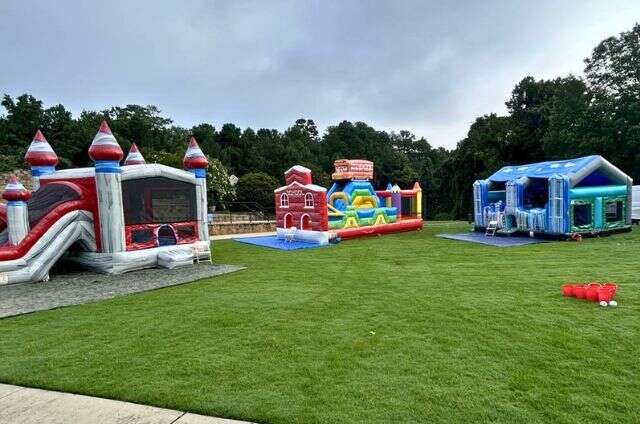
Tweens occupy an awkward middle ground. They're too big and energetic for standard residential bounce houses, but not quite ready for adult-rated equipment. They also become increasingly self-conscious—"babyish" themes and designs won't fly.
What Works for Ages 10-12?
Look for inflatables that offer physical challenge and competition:
- Large combo units (20x20+): Multiple zones, tall slides, climbing features
- Obstacle courses: Competitive racing format, tunnels, climbing walls, slides
- Interactive games: Basketball shootout inflatables, jousting platforms, bungee runs
- Dual-lane slides: Racing element makes sliding competitive
Tweens respond well to competitive elements. An obstacle course where kids race each other holds attention far longer than an open bounce area. Obstacle course rentals are particularly popular for this age group at school field days and youth group events.
Weight and Space Considerations
By age 10-12, kids weigh significantly more than younger children. A standard 13x13 bounce house rated for 6-8 kids assumes elementary-age weight. With tweens, that same unit comfortably fits 4-5 kids maximum.
Always check:
- Total weight capacity — should be 800+ lbs for tween groups
- Per-user weight limit — often capped at 150-200 lbs per person
- Recommended user count — rental companies list this based on unit size and blower strength
Undersized equipment for tweens leads to poor experiences—constant collisions, flattened bounce surfaces, and kids exiting after 20 minutes because it's too crowded.
Teens (Ages 13+): Adult-Rated Inflatables and Interactive Games
Most teens won't be interested in traditional bounce houses. They're too big, too self-aware, and frankly, too heavy for equipment designed for kids. But that doesn't mean inflatables are off the table—it means you need adult-rated options.
What Teens Actually Want
Teens gravitate toward inflatables with these characteristics:
- Physical challenge: Obstacle courses, rock climbing walls, bungee runs
- Competition: Racing formats, jousting, basketball shootouts
- Spectacle value: Mechanical bulls, wipeout-style games, giant slide complexes
- Social elements: Activities where friends compete or spectate
Popular teen-friendly inflatables include:
Obstacle Courses
40-60 feet long, multiple challenge zones, racing format. Built for speed and competition. Rated for adult weight.
Mechanical Bulls
Spectator-friendly, social, and photo-worthy. Speed adjusts for skill level. Popular at corporate events and grad parties.
Interactive Games
Jousting, gladiator duel, bungee basketball. Competitive 1v1 formats. High energy, short turns, perfect for rotating large groups.
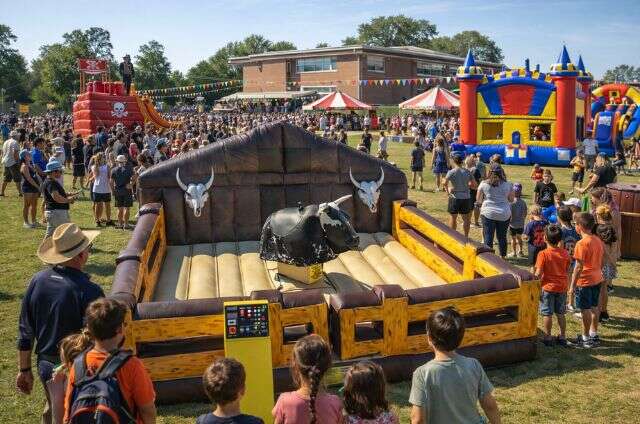
💡 Pro Tip: For teen events, focus on variety over duration. Teens won't bounce for 2 hours straight, but they'll enthusiastically rotate through 3-4 different activities (obstacle course, mechanical bull, basketball shootout) for short bursts. Multiple attractions keep energy high and prevent boredom.
Mixed-Age Parties: How to Keep Everyone Safe and Happy
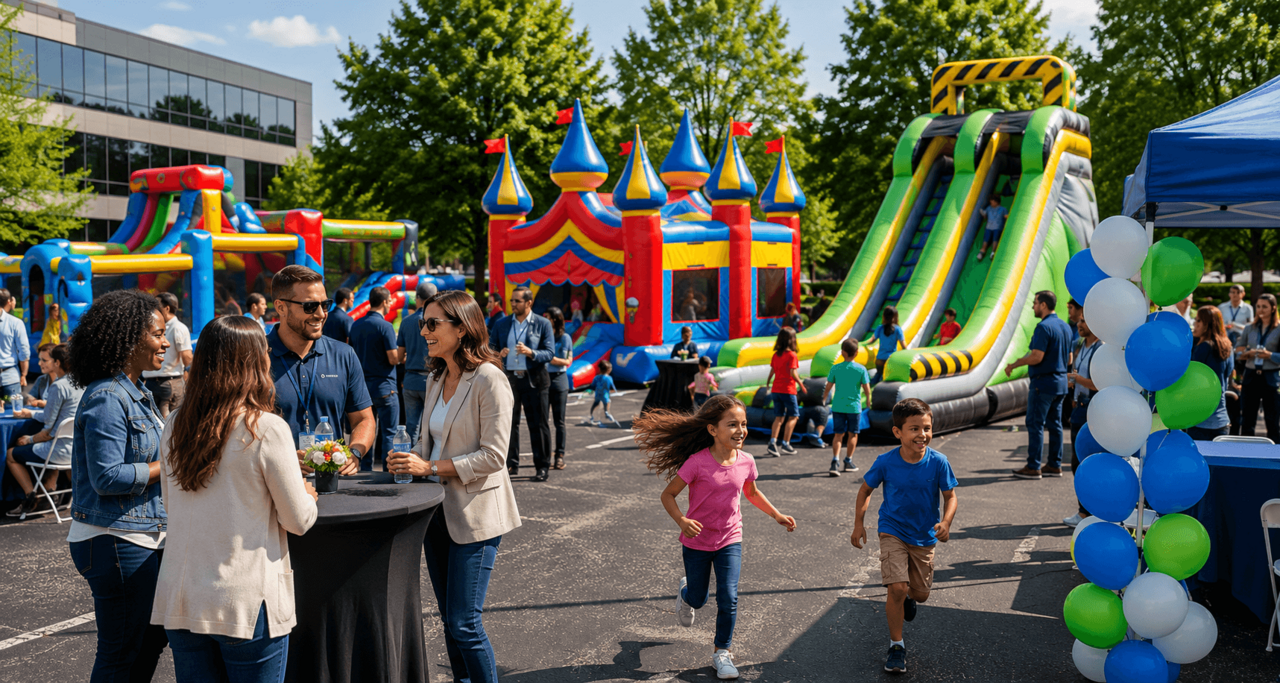
Family reunions, church events, neighborhood block parties—these gatherings include toddlers through teens. One bounce house won't safely serve everyone. The solution requires either multiple units or structured time blocks.
Strategy 1: Rent Multiple Units (Safest Option)
If budget and space allow, separate inflatables by age group:
- Toddler zone: Small bounce house or toddler jumper, adult-supervised, ages 2-5 only
- Elementary zone: Standard or combo bounce house, ages 6-10
- Older kids zone: Obstacle course or interactive game, ages 11+
This approach eliminates collision risk and ensures every age group has appropriate equipment. For large community events, see our guide on large event rentals.
Strategy 2: Scheduled Time Blocks (Budget-Friendly)
If you're renting one unit, enforce strict age-group rotation:
- 11:00-11:30: Toddlers only (ages 2-5)
- 11:30-12:15: Elementary kids (ages 6-9)
- 12:15-1:00: Older kids (ages 10+)
- Repeat schedule as needed
Post a large, visible schedule and assign an adult "bouncer" to enforce it. No exceptions, even for siblings. "Just for a minute" inevitably leads to a toddler getting knocked down.
What About Family-Friendly "All Ages" Units?
Some combo units advertise "ages 3-adult" ratings. While technically accurate (the unit can support adults), this doesn't mean a 3-year-old and a 13-year-old should use it simultaneously.
Age ratings describe structural capacity, not safe mixing. A bounce house that holds 1000 lbs can accommodate adults—but that doesn't make it safe for toddlers to share space with those adults.
🚨 Non-Negotiable Rule: Never allow children with a 4+ year age gap or 40+ lb weight difference to bounce together. The injury risk is too high. If you can't separate ages with multiple units or time blocks, you shouldn't be operating a bounce house.
How Size and Weight Capacity Relate to Age
Age recommendations on bounce houses correlate directly with physical dimensions and weight limits. Understanding how these factors interact helps you choose the right equipment.
Weight Capacity: Total vs. Per-User Limits
Every bounce house lists two weight specifications:
- Total capacity: Maximum combined weight at any moment (e.g., 800 lbs)
- Per-user limit: Maximum weight per individual (e.g., 150 lbs per person)
Why both matter: You might have 6 kids who collectively weigh 600 lbs (under the 800 lb total), but if one weighs 180 lbs, they exceed the per-user limit. That heavy load concentrated in one spot during a jump can damage seams or stress anchoring.
Per-user limits typically range:
- Toddler units: 60-80 lbs per child
- Standard units: 100-150 lbs per child
- Large combos: 150-200 lbs per person
- Adult-rated units: 200-250 lbs per person
How Many Kids Fit? The Real Numbers
Rental companies list "capacity" numbers, but those often represent maximum legal load, not comfortable play. Use these guidelines for active, enjoyable bouncing:
10x10 or 13x13
Listed capacity: 6-8 kids
Comfortable reality: 4-6 toddlers or 3-4 elementary kids
15x15
Listed capacity: 8-10 kids
Comfortable reality: 6-8 elementary kids or 4-5 tweens
20x20+ Combo
Listed capacity: 12-15 kids
Comfortable reality: 8-10 elementary kids or 6-8 tweens
When in doubt, underestimate capacity by 25-30%. Kids have more fun when they have room to move without constant collisions.
Entry Height and Climbing Ability by Age
Entry point height determines whether kids can safely get in and out independently:
- 12-18 inches: Toddlers can step up independently with minimal help
- 24-36 inches: Elementary kids climb up easily using the inflated step
- 40+ inches: Requires good upper body strength — older kids and teens only
If you're constantly lifting kids into the bounce house, it's too tall for their age group. If older kids are bored because the entry is too easy, they need a larger unit with more challenging features.
Frequently Asked Questions
What age is a bounce house good for?+
Bounce houses are typically designed for children aged 2 through 12, though many models accommodate teens and even adults. Toddlers aged 2-5 need low-entry units with smaller bounce areas and gentler features. School-age kids (6-12) can handle larger structures with slides and obstacles. Teens prefer combo units with basketball hoops and challenging elements. Always check the manufacturer's age and weight recommendations for each specific inflatable.
How old do kids have to be for a bounce house?+
Most bounce house manufacturers recommend a minimum age of 2 years old. Children younger than 2 typically lack the motor control and balance needed to safely navigate an inflatable environment. They're also at higher risk of being accidentally bumped by older, more active children. For very young toddlers just turning 2, look for dedicated toddler units with lower walls, softer landings, and restricted entry to prevent older kids from joining.
Is a bounce house safe for toddlers?+
Yes, when you choose age-appropriate equipment and supervise actively. Toddler-specific bounce houses feature lower entry points (12-18 inches instead of 3+ feet), smaller bounce areas to prevent high jumps, and often have mesh sides for constant visibility. The key is separating toddlers from older children—mixing age groups is the primary cause of bounce house injuries in young children. Always maintain one adult supervisor within arm's reach of toddlers while they're bouncing.
Can you put different age groups in the same bounce house?+
It depends on the age gap and the unit size. Toddlers (2-5) should never share space with school-age kids or teens—the size and energy difference creates collision risks. Kids aged 6-9 and 10-12 can often bounce together safely if the unit is large enough and you enforce no-roughhousing rules. For mixed-age parties, consider renting multiple units or scheduling bounce time in age-group shifts: toddlers first, then elementary kids, then teens. This approach keeps everyone safe and ensures each group actually enjoys their time.
What size bounce house do I need for 10 kids?+
For 10 kids, size depends on their ages. Toddlers need less space per child—a 10x10 or 13x13 unit works for up to 8-10 toddlers since they don't jump as vigorously. School-age kids (6-12) need more room to move—a 15x15 standard bounce house comfortably fits 6-8 active kids, so for 10 you'd want a 15x20 or larger combo unit. General rule: allow roughly 20-25 square feet per school-age child for comfortable, safe bouncing without overcrowding.
Do bounce houses have weight limits by age?+
Bounce houses have weight limits per user and total capacity, not strictly by age. However, age correlates with weight, so manufacturers often list both. A toddler unit might allow 4-6 kids with a 300-400 lb total limit. Standard units support 600-800 lbs total, typically 6-8 school-age children. Larger combo units can handle 1000+ lbs. Always check the specific inflatable's capacity—it's determined by the blower strength, seam construction, and anchoring system, not just the bounce area size.
Need Help Choosing the Right Bounce House for Your Event?
We understand that selecting age-appropriate inflatables can feel overwhelming, especially when you're planning for mixed age groups or large guest lists. Our team knows which units work best for toddlers, which combos keep elementary kids engaged, and which attractions teens actually enjoy.
Whether you're planning a backyard birthday, a school field day, or a church event, we'll help you match equipment to your guests' ages and ensure everyone stays safe and entertained.
No pressure, no pitch—just straightforward answers about what will work best for your specific situation.
Call us at 678-752-8718 with any questions about age-appropriate rentals
For more helpful guides on planning successful events, explore our bounce house planning resources or check out our complete event planning guide.